
- The national employers’ association calls for the first wind farm to be located in the Canary Islands, while the Xunta points to the leadership of its industry and the quality of its wind
The Ministry for Ecological Transition closed the period for participation in the public consultation on the order that will govern Spain’s first offshore wind auction on 24 February. Thanks to their natural resources, Galicia and the Canary Islands are two of the regions aspiring to host the first wind farms, although for years some companies in the sector and public bodies have unofficially expressed a preference for the islands to be the first to deploy this technology nationwide. Now, that demand has become official through the submissions sent by the national employers’ association, the Asociación Empresarial Eólica (AEE), to the department headed by Sara Aagesen, and likewise by various companies that have spoken in the same vein.
The Canary Islands is a territory where fossil fuels still carry considerable weight in electricity generation —which drives up costs— so the installation of off-shore wind farms would contribute to replacing them with renewable energy. In addition, there is an institutional current in favour of deploying this type of installation in its waters, and its winds are ideal for turning the blades of offshore wind turbines.
“The association and the sector are clear that the first auction has to be a total success,” states Juan de Dios López-Leiva, the organisation’s technical director. For this reason, in consensus with the companies, they propose starting with a wind farm of around 200 megawatts of capacity, which could be made up of between 12 and 15 wind turbines. One of the companies publicly backing this proposal is the Spanish firm Ocean Winds. “It will send a clear message to the market,” said Manuel García, the company’s director in Spain, on the social network LinkedIn.
However, in order to reach the target of 3 gigawatts of offshore wind installed capacity set out in the Integrated National Energy and Climate Plan (PNIEC), the sector considers it essential that the Government present a scheduled plan for the subsequent auctions, so that all the capacity planned up to 2030 has been put out to bid. “I believe that in the following tenders, Galicia should be included,” added the wind employers’ association’s technical director.
Other considerations submitted to the Ministry for Ecological Transition include that there should be no competition between areas, but rather between projects for the same area. Another proposed requirement is technical and economic viability: “It is important to ensure that both the players and the project present a robust solution that will be carried through to completion,” explains Juan de Dios López-Leiva, who calls for attention to the lessons learned in France, where this criterion rose from representing 5% of the non-economic criteria to 12%.
On the economic front, the association asks for contracts to have a minimum duration of 20 years —with the possibility of extending them to 30— and with prices that include indexation mechanisms, among other measures. For Ocean Winds’ director in Spain, it will also be advisable to establish a solid and stable economic regime “with an adequate reserve price, indexation mechanisms and clear long-term rules that provide certainty for developing projects.”
The national employers’ association also calls for measures to be put in place to limit the impact of legal challenges to projects.
Regional demand
Although the Xunta shares some of the proposals put forward by the national association —such as that territories should not compete with each other for projects— it demands that Spain’s first offshore wind farm be located in Galician waters. Specifically, in the areas designated as Nor-4 (off the Rías Altas) and Nor-5 (in A Mariña Lucense) in the Maritime Spatial Plans (POEM). These areas make it possible to “take advantage of the existence of 400 kV nodes along the Galician coast with capacity for the interconnection of new electricity generation facilities, as well as the use of existing port infrastructure (…), compatible with the development of offshore wind projects,” it stresses.
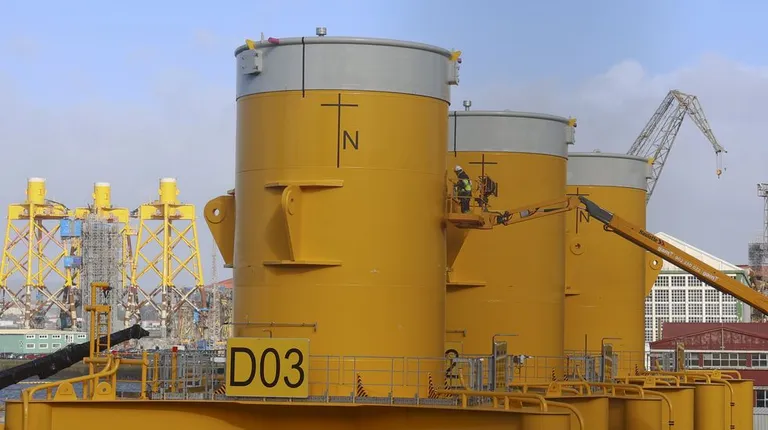
The Galician Government bases this demand on the fact that the region “has one of the most complete industrial ecosystems in Europe in offshore wind, with shipyards and auxiliary companies already taking part in international projects; has experience in manufacturing marine structures, floating platforms and critical components; has an exceptional wind resource in terms of equivalent hours and stability, and has port infrastructure —in A Coruña, Ferrol, San Cibrao and Vigo— suitable for assembly and logistics.
The Xunta advocates starting the sector with small wind farms “that help advance the technological development of floating offshore wind and to test this development and facilitate integration into the territory.” To avoid “speculative behaviour,” it also argues for weighting “prior and accredited technical solvency, economic and financial solvency that guarantees the developer’s continuity throughout the entire service life and the subsequent decommissioning of the project, as well as demonstrable and proven experience in developing complex energy projects.”
For the Galician Government, the criterion that should carry the most weight in the future auction is the compatibility of uses at sea, followed by the lowest environmental impact and the exploitation of the industrial opportunity.
As for the economic criteria, the contributions of the Galician Government, made by the Director General for Energy Planning, Pablo Fernández Vila, consider that “price indexation should not be limited solely to updating industrial prices, but should include compensatory measures for affected sectors.” In addition, it advocates setting a maximum term for projects consistent with their financing, in order to guarantee sufficient stability to attract investment. “A longer duration will reduce financial risk and allow more competitive bids to be made in the auction, but it must also be necessary to guarantee the developer’s obligations, including at the end of the service life,” adds Fernández Isla.
Direct compensation mechanisms for the fishing sector
For offshore wind to reach a successful conclusion in any country, understanding with the fishing sector is indispensable. The Asociación Empresarial Eólica considers that there are direct mechanisms, such as the payment of a fee, which also help to maintain a smooth relationship between the parties. “In France it involved a payment of 12 million euros for the renewal of the fleet,” states the organisation’s technical director. The Xunta also emphasises that the possibility of establishing compensation and promoting synergies with the fishing sector “must be extensively worked on by the developer.” It recalls that, under the natural resources law, any offshore wind project must leave wealth in the territory.


