
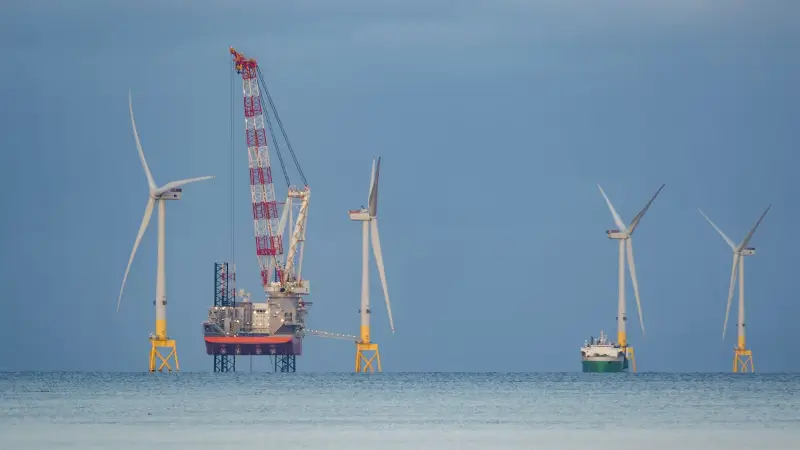
The DemoSATH two-megawatt (MW) floating offshore wind turbine has been generating renewable energy for around 2,000 households since 2023. Installed at a depth of 85 meters off the coast of Armintza (Bizkaia) in the BiMEP (Biscay Marine Energy Platform) test area, the prototype has withstood wind gusts exceeding 144 kilometers per hour and waves reaching 13.12 meters. Beyond weathering the rough and unpredictable Cantabrian Sea, it serves as a “living laboratory”: the Basque company Saitec, co-developer of the project alongside Germany’s RWE Renewables and Japan’s The Kansai Electric Power, is also studying its coexistence with the oceanic ecosystem, birdlife, and bats. To date, research conducted in England, France, and Portugal also indicates that these platforms boost biodiversity by acting as artificial reefs that provide shelter and food for hundreds of species, notes Juan de Dios López Leiva, Technical and Industrial Director of the Spanish Wind Energy Association (AEE).
Delays and concerns
Spain currently has barely 5 MW of installed offshore wind capacity, all floating and in the testing phase, except for a pilot project at the Oceanic Platform of the Canary Islands (Plocan)—the country’s other major national testbed—which uses fixed-bottom technology. Although Spain is an industrial powerhouse—”out of the 50 existing prototypes worldwide, 14 feature Spanish patents,” López highlights—commercial deployment is lagging behind the strong momentum seen in the United Kingdom and the North Sea.
Compounding the technical viability challenges—since the continental shelf is narrow and drops to great depths close to the coast (exceeding 85 meters just three kilometers out), rendering the established fixed-bottom technology of Northern Europe unfeasible—are the government’s delay in launching the first auction to kickstart activity and fears of pushback against its expansion due to potential socioeconomic and environmental damage, as has occurred with onshore wind power in autonomous communities like Galicia. In fact, three years ago, designated zones for development were outlined with the approval of the maritime spatial planning plans (POEM) to avoid future conflicts with fishing or navigation. “Every project is required to submit a specific study on birdlife, underwater noise, benthic habitats, fishing, landscape, and potential cumulative effects,” points out Beatriz Spuch, coordinator of the Marine Renewable Energy Working Group at the Spanish Association of Naval and Oceanic Engineers.
“We have installed nature-based elements and systems to analyze the habitat colonization of native species and the potential integration of aquaculture,” Saitec representatives add. On the submerged columns, they have placed biomimetic (blue-gray) natural-substrate structures composed of calcium carbonate and minerals that mimic natural reefs, filled with shells and mussels. Designed as three-dimensional modules, they provide stratified habitats for fish nurseries, micro- and macrofauna, and benthic organisms (clams, algae, oysters), they detail. “This reef and reserve effect is also being observed in Viana do Castelo (Portugal) at the WindFloat Atlantic project; there are significantly more octopuses in the area. Since the Portuguese government prohibited fishing around the facility, certain species concentrate and reproduce more within the wind farm,” López explains.
Ocean Winds, owned 50% by EDPR and Engie and holding a 21-gigawatt (GW) portfolio, is the firm behind this 25 MW semi-submersible platform, operational since 2020. “We have a long-term environmental monitoring program, and this year a report prepared by the consultancy Blue Grid was presented—with contributions from the Center for Marine and Environmental Sciences (MARE) at the Faculty of Sciences of the University of Lisbon (MARE-ULisboa) and the Polytechnic of Leiria (MARE-IPLeiria)—identifying more than 270 species in the area, including 52 varieties of fish, 33 of birds, five of marine mammals, and three of bats,” details Manuel Fernández García del Campo, Business Development Director for Spain at the company.
The AEE expects that before the end of the year, the Ministry for the Ecological Transition and the Demographic Challenge (Miteco) will publish the order setting the ground rules for the auction—a step prior to a call for tenders they anticipate for 2027 in an optimistic scenario. “It is impossible to meet the 3 GW target by 2030 established in the National Integrated Energy and Climate Plan (PNIEC). Given the required timelines, permits, administrative procedures, construction, and commissioning, it would be practically impossible to see connected installations before 2034 or 2035 if awarded now,” laments López, though he stresses that the priority is to launch an activity that is new and requires a transparent deployment schedule. “Since these projects are highly capital-intensive and require lengthy development and preliminary studies, visibility regarding zones, capacity, and dates is crucial,” he emphasizes. The cost ranges between four and six million euros per MW, he adds.
Building expectations
While awaiting the auctions, NextFloat is generating expectations in Catalonia. The government has just given the green light to the first turbines at the Experimental Marine Platform of Catalonia (Plemcat), off the Empordà coast, scheduled to become operational in 2028. The 8.5 MW test project is led by France’s Technip Energies and Catalonia’s X1 Wind. “It is essential to guarantee maximum safety and absolute respect for the environment. The X100 platform—featuring tension-leg platform (TLP) technology, a semi-submersible structure, and a downwind turbine with a 160-meter diameter—has obtained strict certification from the global safety group DNV (Det Norske Veritas) and received a favorable environmental impact assessment from Miteco,” express representatives from X1 Wind, which also tested its technology at Plocan (Canary Islands) through the PivotBuoy initiative alongside an enterprise consortium. “This system reduces environmental impact by occupying a smaller seabed footprint compared to traditional catenary systems; it is compatible with fishing; by utilizing tensioned synthetic mooring chains and eliminating traditional ones, we prevent seabed dragging and underwater noise; placement methods using suction piles or water jets are quieter; and the structures are lighter, requiring 50% less steel than existing alternatives and allowing towage by small- to medium-sized vessels,” the developing firm maintains.
López clarifies that bottom trawling is incompatible with offshore wind farms, whereas artisanal fishing is not. “A study by the Spanish Institute of Oceanography (IEO-CSIC) notes that if 100% of high-potential zones for offshore wind energy (Zaper)—which account for just 0.43% of territorial waters—were occupied and fishing prohibited, the drop in catches would be merely 4% overall. Development must be gradual and informed, which is precisely what is being worked on,” he argues.
Very close to the Catalan project, in the Gulf of Lion (southern France), the French Executive is testing a 30 MW platform also developed by Ocean Winds, with support from Banque des Territoires, operational since last May. The neighboring country has already launched four staggered tenders—some for 250 MW and up to 600 MW—a model to emulate according to the Spanish trade association. “You call auctions for smaller wind farms, and as you get to know the site through monitoring, you award the larger ones,” they explain. France is also an example regarding introduced compensation measures: the French government allocated 12 million euros to renew the fishing fleet in areas where the first farms were deployed—in Saint-Nazaire, Saint-Brieuc, and Fécamp (to the north in Normandy and Brittany, respectively)—funded through a levy imposed on companies for impacting fishing activities (some fishermen had to vacate their traditional fishing grounds).
A powerful naval industry
In Galicia, the focus for now is more on manufacturing, leveraging a well-established shipbuilding industry. Although the future goal is to host half of the 3 GW target set by the PNIEC, aspirations shared by Manuel Pazo, president of the Wind Energy Association of Galicia (EGA). “The central government has granted 100 million euros in aid to adapt the ports of A Coruña and Ferrol for building platforms, which resemble oil rigs; measuring the size of a football pitch, they cost around 20 million euros—double the price of a turbine,” he illustrates. Logistics and maintenance vessels, alongside structures and electrical substations exported abroad—especially to Northern Europe—add to the list.
In fact, Spain’s primary exports in this sector are maintenance and service vessels, notes López. “Navantia, which has built half of Europe’s platforms, and Windar are major players in manufacturing. We have technology developers and power generator manufacturers, such as the Cantarey plant in Reinosa, Cantabria [owned by Siemens Gamesa],” he cites. “These conceptual developments have established a highly robust ecosystem comprising engineering firms, universities, technology centers, ports, and shipyards deeply linked to these projects and participating in international endeavors,” highlights Spuch.
Navantia Seanergies—the energy division of the naval giant that has built over 200 jackets, 80 monopiles (lattice or tubular foundations), five electrical substations, and 70% of the world’s existing steel floating structures alongside its partner Windar Renovables over 12 years of activity—is investing in adapting its Fene plant (A Coruña) to transform it into a European-scale high-voltage alternating current substation manufacturing hub. “Following a period of deceleration in Europe and the United States, demand is growing once more on more realistic and sustainable foundations,” they observe.
Pazo, however, fears that opposition groups might stall an activity seen as business diversification for shipyards. “Environmental impact is impossible to eliminate entirely; what must be achieved is minimizing it. Does it alter the landscape? Of course. Do we want clean, cheap electricity? The impact is minimal with this technology. My view is that marine resources are perfectly compatible with wind energy; they act like cities at sea that will ultimately aid fishermen,” he contends. Regarding birds, he asserts that the machines cease operation as soon as sensors detect them. Furthermore, the turbines—standing around 200 meters tall—rotate as slowly as possible to reduce noise and pressure waves. “Demonstrator projects utilizing cameras, bird detection systems, acoustic sensors, sonar, underwater robotics, and environmental DNA are invaluable because they allow us to learn about significant impacts and how to mitigate them before moving to commercial-scale farms,” Spuch adds.
“It makes complete sense to start in the Canary Islands: there is social and political acceptance, and the region is largely non-decarbonized. The energy development plan for the archipelago envisions 130 MW in Tenerife and 200 MW in Gran Canaria,” López reasons. The consulted companies demand grid access and connection, industrial capacity and port adaptation, supply chain reinforcement, administrative and regulatory certainty, subsidies for pre-commercial and commercial initiatives, and tangible project execution.
Saitec’s SATH technology utilizes concrete because it reduces costs and environmental footprint compared to steel. “Manufacturing and supply are local, fostering regional employment and avoiding vulnerability to international price volatility and supply chain disruptions,” they argue. All that remains is for the wind to blow in their favor and ignite the engines of this promising industry.


