
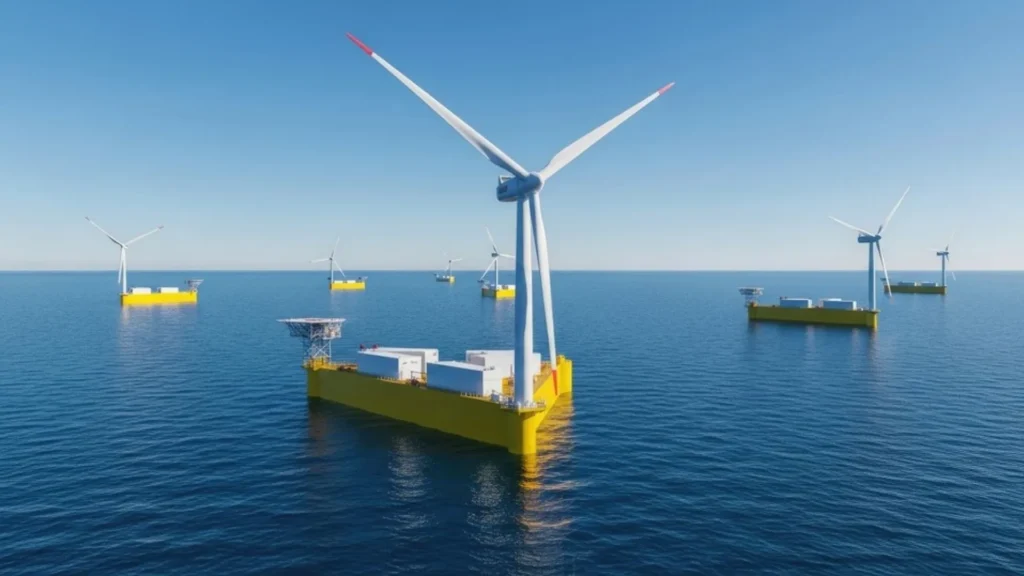
Norway has allocated 3.94 billion Norwegian kroner, around 428 million dollars, to fund two pilot projects for floating offshore wind energy. The funds will be channelled through Enova, a government agency promoting the development of new energy technologies and solutions.
The announcement, made on October 30, 2026, foresees the installation of high-power offshore wind turbines over the next five years. With these initiatives, the country aims to test the performance of new technologies and find ways to reduce electricity generation costs at sea.
Enova will fund two floating offshore wind energy projects
The grants will be distributed between two Norwegian companies: Fortius Offshore Wind AS will receive 2 billion Norwegian kroner, while Fram Wind Solutions AS will obtain 1.94 billion kroner to develop their respective demonstration projects.
According to the published information, both companies plan to install two offshore wind turbines of 18.5 megawatts (MW) each. So far, the exact locations of the projects and the specific characteristics of the technologies to be used have not been detailed.
The installations are scheduled for development over the next five years, during which the companies will test solutions aimed at improving the technical and economic performance of floating wind systems.
The experience gained will be key to understanding how these technologies operate in real-world conditions and evaluating their application in future, larger-scale developments.
The wind turbines would generate electricity for 15,000 households
Together, the projects contemplate an estimated annual production of 0.3 terawatt-hours (TWh); according to Enova, this amount of electricity is roughly equivalent to the annual consumption of 15,000 households.
This generation forecast will depend on the commissioning of the facilities and their operational performance.
Unlike conventional offshore wind farms, which use structures fixed directly to the seabed, floating technology installs wind turbines on platforms supported by floating and mooring systems.
This setup allows for the exploitation of wind resources in deeper waters, where building fixed foundations is technically complex or overly expensive.
Therefore, floating wind power represents an alternative to expand the areas available for offshore renewable generation.
Reducing generation costs is the main challenge
The purpose of the funding is not limited to adding new power generation capacity; Norway aims to verify whether the technologies to be tested can successfully reduce the costs associated with developing and operating floating wind farms.
The pilot projects will allow for analyzing equipment behavior, identifying potential improvements, and gathering technical data prior to moving toward larger commercial installations.
Enova considers that achieving a competitive cost level would be a major milestone in promoting the use of this technology in the energy sector.
Currently, offshore wind energy faces hurdles related to high upfront investments, financing costs, and the complexity of installing and maintaining large offshore structures.
In the case of floating systems, these challenges become particularly significant due to the technical demands of platforms, moorings, and subsea electrical connections.
For this reason, testing new solutions before scaling up commercial deployment is fundamental to establishing their economic viability.
Norway bets on the development of new wind technologies
With this investment, Norway reinforces its commitment to innovation in floating offshore wind energy and the development of technologies to harness renewable resources in deep waters.
The projects by Fortius Offshore Wind and Fram Wind Solutions will serve to evaluate different solutions under real operating conditions and gather insights on their costs and performance.
Over the next five years, the progress of both initiatives will provide a clearer understanding of the technology’s possibilities and the obstacles that remain to be overcome.
The results will be decisive in proving whether floating offshore wind energy can lower its costs and become a more competitive alternative for large-scale renewable electricity generation.


