
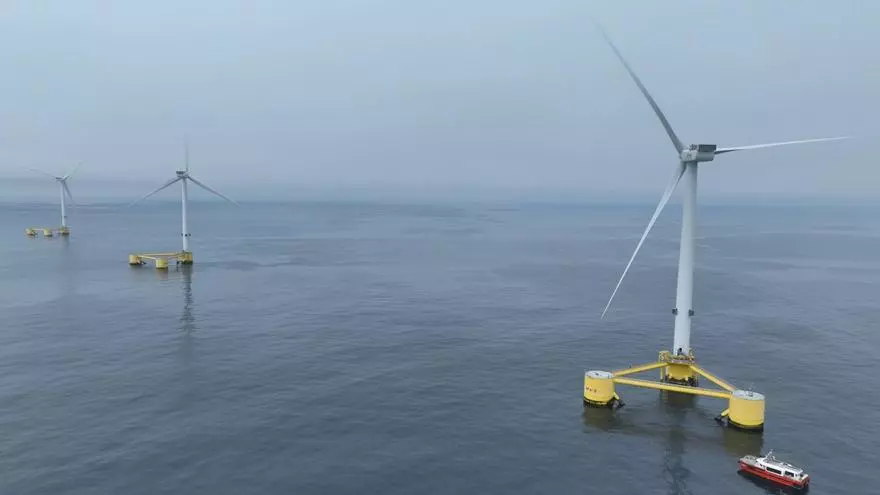
The Xunta has raised its hand on many occasions to offer Galicia as the ideal place to launch offshore wind in Spain. When the Ministry for Ecological Transition put out for prior consultation, at the beginning of last month, the order that will regulate “the first competitive tendering procedure” in the sector, the regional minister for Economy and Industry reiterated the point. “We demand that Galicia be one of the first regions where auctions begin to be developed,” said María Jesús Lorenzana. And the submissions from her department on the regulation that will drive the bidding endorse the request for the umpteenth time, this time in more specific terms: that it be held in the north of the region and with a small-sized wind farm.
Which is the best area, or areas?
“Without prejudice to the possibility that other territories may be included in the procedure, the inclusion of the high wind potential zones off the Galician coast of the North Atlantic Demarcation in the first competitive tendering procedure would give rise to a first auction whose resulting projects would be connected to the mainland electricity grid,” states the regional department, in response to the question posed by Sara Aagesen‘s team on which of all the areas that the Maritime Spatial Plans (POEM) consider suitable for offshore wind should be selected for the auction. Economy’s remark is significant.
Everything points to the Canary Islands having the advantage because they have the best wind conditions and, in addition, the archipelago needs to be self-sufficient and its electricity production costs are four times higher. Hence the Galician administration does not close the door to developing offshore wind in other locations, but plays the card that, in its case, the wind farm would make it possible to test the integration of this new renewable energy source on the Peninsula. “It is considered,” it insists, “that the first auction must prioritise the POEM zones of the North Atlantic demarcation in Galicia.”
What works in its favour?
The regional government points to the existing high-voltage (440 kilovolt) electricity evacuation nodes in “the Galician coastal area” with capacity for connecting new generation facilities, “as well as the use of existing port infrastructure in Galicia compatible with the development of offshore wind projects.” And it adds a caveat: the procedure “must be developed from the perspective of coexistence and compatibility of uses of the sea, in order to give it greater legal certainty” in view of the “high fishing intensity” along the regional coastline. “Although,” it continues, “without forgetting the high degree of Galician industrial development in the field of fixed offshore wind and the great possibilities of leveraging that experience for floating offshore wind projects.”
Despite the complaints the regional department repeatedly makes about the alleged congestion of the region’s electricity grid, as a credential for bringing offshore wind here it appeals to “territories such as Galicia, which have a solid electrical infrastructure and capacity to connect to the electricity transmission grid.” “Which is an advantage over non-mainland territories,” it adds. It speaks of “differential conditions” in Galicia, for hosting “one of the most complete industrial ecosystems in Europe” in offshore wind, “an exceptional wind resource in equivalent hours and stability” and the strength of the ports of A Coruña, Ferrol, San Cibrao and Vigo for assembly and logistics.
And what is the best option?
For the first time, the Xunta identifies two zones. The two polygons reserved furthest north because they have a 440 kV substation. NOR-4, with a surface area of 77 square kilometres and located 22.5 kilometres from Estaca de Bares; and NOR-5, in A Mariña de Lugo, with 236.3 square kilometres of space and located 21 kilometres from land.
And what about competition between zones?
The Xunta does not consider it “the most appropriate.” “The process should be designed so that analogous projects are compared, making it possible to select the best project and thus guaranteeing technical and economic competition on equal terms,” it conveys to the Ministry for Ecological Transition, with a view to “optimising” the social benefits of the projects. “As this is the first procedure, the priority objective must be to guarantee the effective execution of the selected projects,” it explains.
What size should the wind farms be?
It does not propose any specific capacity, unlike the sector itself, which points to around 200 megawatts (MW). The regional department headed by Lorenzana defends the importance of “weighing economies of scale factors,” but does call for initially leaving out “a high-capacity offshore wind farm” and starting with “smaller installations that help advance technological development.” In its opinion, the best approach is to set “a range of capacities that ensures financial viability, while prioritising technological quality.”
What criteria should be used for selection?
The Xunta wants the main one to be the compatibility of the wind farm with other uses of the sea. The rest, in this order of importance, are: minimising environmental impact, taking advantage of the industrial opportunity, support for the project from citizens, administrations and other bodies, innovation and, lastly, an economic price for the energy. In any case, it calls for “rigorous” requirements to “avoid speculative behaviour” that ends with projects left undeveloped.


