
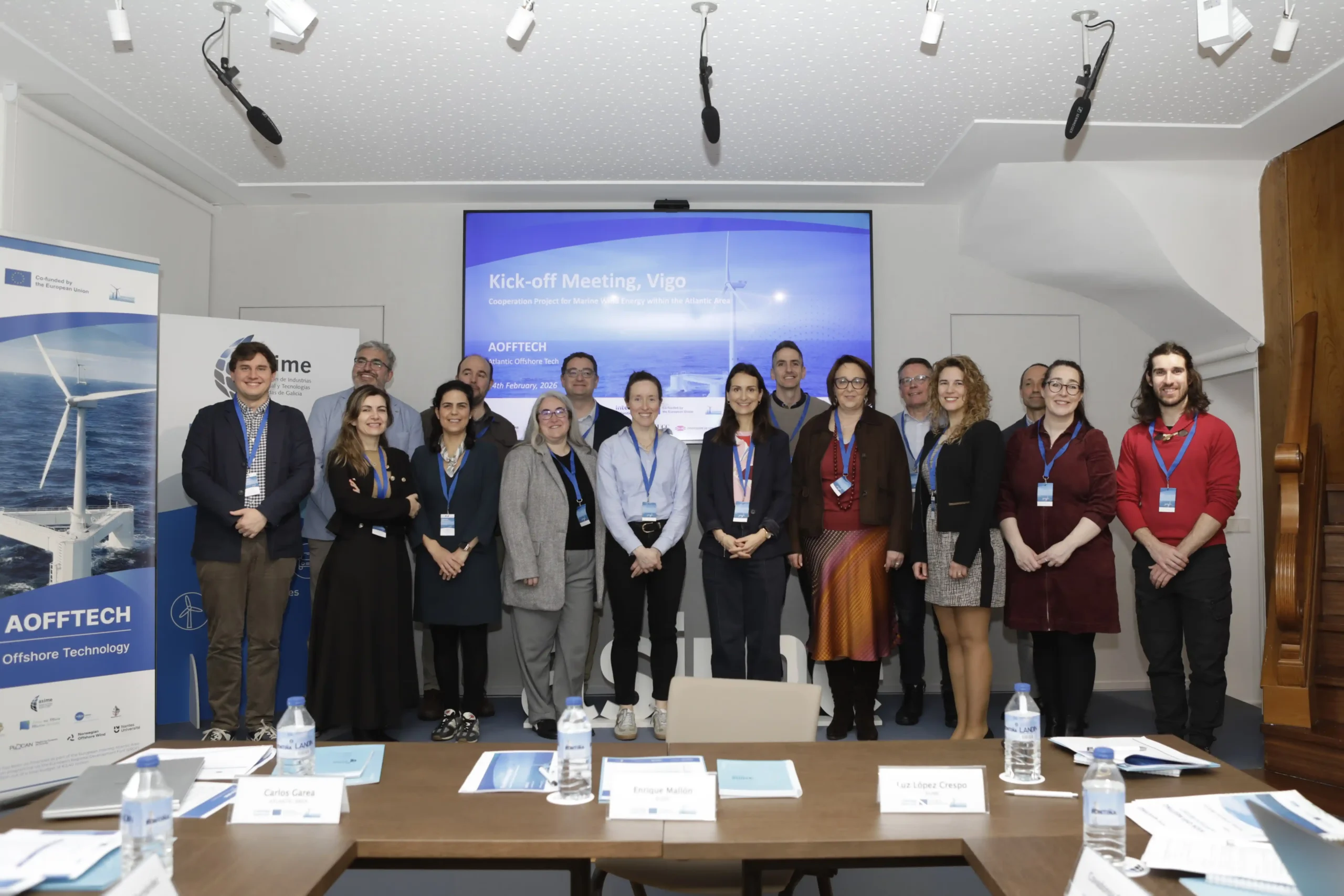
On February 24th, the launch of the AOFFTECH project (Atlantic Offshore Technology) took place in Vigo — a new international initiative focused on the development of floating offshore wind energy, funded through the Interreg Atlantic Area Programme.
The project brings together organizations from various countries in the Atlantic Arc with the aim of driving the energy transition, contributing to the decarbonization of the economy, and strengthening European energy independence in the context of the fight against climate change.
Over 30 months, eleven organizations from Spain, Portugal, France, Ireland, and Norway will work together to promote technological cooperation and knowledge exchange around the deployment of offshore technologies, with special attention to floating offshore wind energy.
Participation of the Universidade da Coruña
The Universidade da Coruña participates in the project through a team of researchers from the Integrated Engineering Group (GII), attached to the Research Centre on Naval and Industrial Technologies (CITENI), and a team from the Technological Innovation Centre in Building and Civil Engineering (CITEEC).
The GII researchers include Vicente Diaz Casas, Rosa Rios Prado, Pedro Manuel Fernandez Rodriguez, and Felix Nieto, the latter belonging to CITEEC.
The UDC’s contribution focuses primarily on Work Package 1, dedicated to the exchange of experiences between experimental platforms, with special attention to the technological deployment of floating offshore wind energy. In this context, the university participates specifically in the task of identifying synergies and collaboration between stakeholders in the floating offshore wind sector, drawing on its expertise in the offshore field.
The activities to be carried out by the UDC within the project include:
- Preparation of a state-of-the-art report, compiling previous studies, technical reports, and relevant projects related to the integration of floating offshore wind technologies. This work will also include analysis of legal frameworks and energy policies, as well as a selection of projects from the Atlantic area to assess potential co-activities using technological, economic, and environmental indicators.
- Definition of classification criteria for co-activities, considering different areas such as energy and storage, industry, logistics, environment, and the blue economy. These criteria will include subcategories and examples to help identify synergy opportunities between sectors.
- Development of an interactive map of relevant stakeholders, identifying companies, research centres, public administrations, and non-governmental organizations linked to the offshore sector, including information on their technical, financial, and regulatory capabilities.
- Preparation of recommendations to improve cooperation between floating offshore wind energy and other economic sectors, with the aim of fostering cross-sector collaboration within the blue economy.
- Definition of a controlled-environment testing protocol, covering technical considerations for the experimental phase of floating offshore wind pilot projects, as well as dissemination activities for these results.
At the same time, the UDC will participate and collaborate with the other partners in the study and development of the remaining work packages:
- Development of ESG guidelines and circular economy criteria to ensure socio-environmental sustainability.
- Creation of a digital ecosystem to support the deployment of floating offshore wind energy in the Atlantic area.
These activities will help strengthen cooperation among sector stakeholders and facilitate the development of new innovation opportunities around floating offshore wind energy.
International Consortium
The project is coordinated by the Association of Metal Industries and Associated Technologies of Galicia (ASIME) and brings together organizations from various countries in the Atlantic Arc:
Project partners:
- ADENE
- PLOCAN
- Marine Institute
- Nantes Université
- Pôle Mer Bretagne Atlantique
- Camara Município de Viana do Castelo
- University College Cork
- Universidade da Coruña
Associated partners:
- Vianapesca
- Norwegian Offshore Wind
AOFFTECH integrates technology, environmental sustainability, and social impact with the goal of advancing towards an effective energy transition in the Atlantic Area.
Previous Experience in Offshore Wind Projects
The Integrated Engineering Group’s participation in AOFFTECH builds on experience gained in previous European projects related to offshore wind energy, such as AOWINDE, developed within the framework of cooperation between Galicia and Northern Portugal within the Euroregion. This track record will allow the group to contribute knowledge and prior results that will feed into the new project, now extending its scope to the entire Atlantic Arc.

