
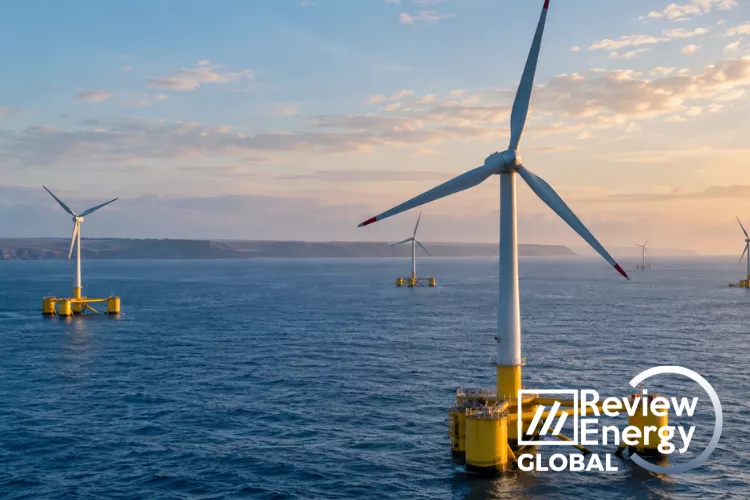
The global floating offshore wind pipeline has now reached 152 GW of operational or developing capacity, spread across 300 active projects in 26 countries, according to RenewableUK’s new report, Global floating offshore wind pipeline October 2026.
The analysis, based on the association’s EnergyPulse database, provides a snapshot of the global market, from the earliest stages of development through to commercial operation, and assesses the sector’s expected evolution over the next decade.
2026 sets a record for new operational capacity
RenewableUK reports that 2026 is already the strongest year to date for floating offshore wind deployment worldwide.
A total of 109 MW of new capacity has come online during the year, bringing the global operational total to 382 MW.
Although the amount currently in operation remains small compared with the size of the announced pipeline, the association considers that the sector continues to have a significant long-term pipeline, despite the challenges faced by the industry in recent years.
300 projects across 26 countries
The report analyses a total of 300 active projects across 26 markets, including operational capacity, projects that have reached financial investment decision (FID), and developments at various earlier stages.
RenewableUK also examines the pipeline by country, project owner, floating foundation technology and turbine supplier, together with deployment forecasts through to 2034.
The report also includes estimates of global investment, future demand for floating foundations, and the expected development of this technology compared with fixed-bottom offshore wind.
The industry looks towards 2034
One of the report’s objectives is to assess how floating offshore wind could evolve over the coming years as projects progress from the early development stages towards construction and operation.
RenewableUK analyses deployment prospects through to 2034, as well as the industrial requirements associated with market growth, particularly in components, foundations and the supply chain.
The association highlights that, despite recent uncertainty in some markets, the scale of the global pipeline confirms that floating offshore wind remains one of the key routes for expanding offshore generation in areas where water depths prevent the use of fixed-bottom foundations.
The UK maintains a significant pipeline
The report also includes a specific analysis of the UK market, covering currently operational capacity, projects with awarded Contracts for Difference, capacity eligible for the next auction round, and growth forecasts through to 2034.
The publication coincides with Floating Offshore Wind 2026, the event organised by RenewableUK and Scottish Renewables, where industry stakeholders will analyse the sector’s commercialisation, cost, financing and supply-chain challenges this week.
The combination of a 152 GW global pipeline and a new annual record for operational capacity shows that floating offshore wind continues to move towards a phase of greater commercial deployment, although a large share of projects is still at an early stage of development.

