
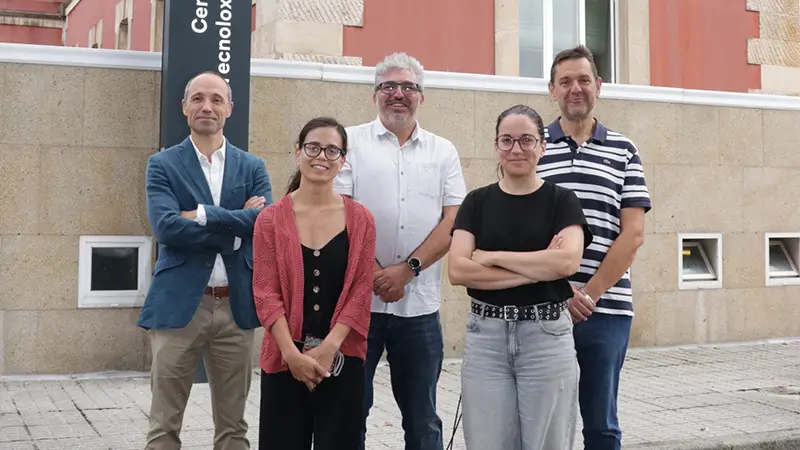
Research staff from the Centre for Naval and Industrial Technologies Research (CITENI) and the Centre for Technological Innovation in Building and Civil Engineering (CITEEC) are participating in the AOFFTECH project: Atlantic Offshore Tech, funded by the Interreg Atlantic Area programme and coordinated by the Galician Offshore Energy Group (GOE-Asime). The team from the University of A Coruña (UDC) leads the study of technological needs for the deployment of experimental floating offshore wind farms in the Atlantic Arc.
Floating offshore wind offers a viable solution for generating electricity in deep waters, where it is not possible to anchor wind turbines to the seabed using piles or other fixed foundations. This technology is particularly well suited to the Atlantic Arc, an area with high wind energy potential but also complex ocean conditions that make traditional solutions challenging.
With the aim of advancing the deployment of this type of infrastructure, the University of A Coruña is collaborating in the European project Atlantic Offshore Tech (AOFFTECH), an international initiative focused on promoting the development of floating offshore wind in this maritime area. The institution participates through the Centre for Naval and Industrial Technologies Research (CITENI) and the Centre for Technological Innovation in Building and Civil Engineering (CITEEC), both with extensive experience in the field of marine energy.
Coordinated by the Galician Offshore Energy Group (GOE-Asime), the project has a total budget of €2.4 million, of which €1.8 million — 75% of the total — is co-financed by the Interreg Atlantic Area programme through the European Regional Development Fund (ERDF). UDC will manage a budget allocation of €243,750 within this funding framework.
Technology, sustainability and knowledge from UDC
The institution coordinates one of the main tasks within the first work package (WP1), aimed at fostering collaboration among companies, technology centres and research organisations in the floating wind sector across the Atlantic euro-region. This action promotes knowledge exchange and the development of technological innovations such as multi-use platforms and green hydrogen. It also seeks to support sustainable development and coexistence with traditional activities in sectors such as aquaculture, tourism and ecosystem monitoring, ensuring positive impacts and mitigating potential effects on local communities.
Within this framework, CITENI, through the Integrated Engineering Group (GII), leads the analysis of technical barriers hindering the deployment of experimental floating wind farms. To this end, it defines a technological roadmap and develops tools to assess the medium- and long-term performance of these infrastructures, as well as their socio-economic and industrial impact. Meanwhile, CITEEC contributes its expertise in civil engineering applied to maritime and energy infrastructures.
“AOFFTECH allows us to provide real solutions from the university so that floating offshore wind moves from being a future prospect to becoming a viable experimental infrastructure,” explains Vicente Díaz, principal investigator of the project at UDC. “From CITENI, we are analysing the current technical barriers to enable experimental platforms to begin operating as soon as possible.”
International cooperation for the energy transition
AOFFTECH is a three-year transnational project bringing together 11 entities from Spain, Portugal, France, Ireland and Norway. In addition to UDC and GOE-Asime, the consortium includes: the Oceanic Platform of the Canary Islands (PLOCAN); the Marine and Renewable Energy Research Centre – University College Cork (MaREI); the Marine Institute (Ireland); École Centrale de Nantes; Pôle Mer Bretagne Atlantique; the Portuguese Energy Agency (ADENE); the Municipality of Viana do Castelo (CMVC); VianaPesca; and the Norwegian Offshore Wind cluster.
Consolidation and technological advancement
AOFFTECH consolidates and expands on the achievements of its predecessor project, AOWINDE: Atlantic Offshore Wind Energy, which focused on strengthening the offshore wind value chain in the Galicia – Northern Portugal Euroregion. While AOWINDE established a solid foundation for institutional collaboration and strategic planning, AOFFTECH goes further in technological, environmental and territorial dimensions and extends its scope to five countries across the Atlantic Arc.
The project’s objective is to develop a common strategy to accelerate the deployment of floating offshore wind, while reinforcing territorial cohesion, environmental sustainability and knowledge transfer. In line with the objectives of the European Green Deal and the continent’s decarbonisation strategy, AOFFTECH promotes coordinated action based on technological development, dialogue with coastal communities and improved regulatory planning, positioning the Atlantic as a key area in the European energy transition.

